Charging by Induction
Check What You Know: Charging by Induction Quiz
Do you really know how to charge an object by induction? Take the 10-question quiz to find out. You won’t need paper or a pencil. Every answer is explained, and each time you play you get a new mix of questions.
Quiz completed … times
Loading…
Your score
What Is Charging by Induction?
Charging by induction happens when we bring a charged object near a conductor. We say near for a reason: the charged object does not actually touch the conductor. It only gets close to it.
As a result, the conductor becomes charged. We say that a charge has been induced in the conductor. An experiment makes this clear.
The Experiment: Charging Two Metal Spheres
Metal is a good conductor, so it is a good choice for this experiment.
1Set up two metal spheres, A and B
- They touch each other, so they act as a single conductor.
- They sit on insulated stands, so charges cannot travel to the ground.
- Right now they form a neutral system: each sphere has the same number of electrons and protons.

2Bring a negatively charged rod close
The rod, shown in green on the right, is negatively charged. The lines inside it stand for negative charges.
Like charges repel, so the rod pushes electrons in sphere B over to sphere A. Sphere A now has extra electrons, a net charge, and sphere B is left with a net positive charge. We say that a charge has been induced on the spheres.

3Separate the spheres while the rod is still there
Keep the rod close and pull the spheres apart. The extra electrons are now trapped on sphere A.

4Remove the rod
Finally, remove the rod completely. The spheres keep their charges. This is what we mean by charging by induction.

The charges are equal and opposite. For each electron that moves to sphere A and gives it one negative charge, sphere B is left with one positive charge.
In our example, 3 electrons moved to A. So A has 3 more electrons than protons (negative), and B has 3 more protons than electrons (positive). Keep in mind that real spheres have billions and billions of electrons, so this is a very small charge.
Charging by Induction and Grounding
You can also charge a single sphere.
1Induce a charge on one sphere
Use only one sphere this time, and bring a negatively charged rod close to it again. Then put your finger on the side where the electrons are.
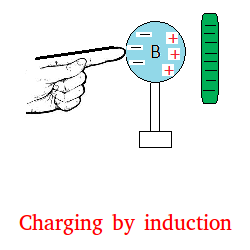
2Touch the sphere
When you touch the metal with your finger, electrons leave the sphere through your finger and go into the ground.
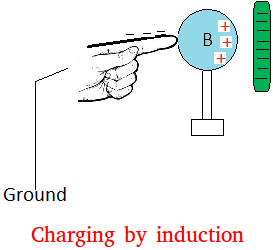
3Take your finger away, then remove the rod
Take your finger away first, then remove the rod. The electrons that left cannot come back, so the sphere is left with a positive charge, the opposite of the negative rod. (With a positive rod, electrons come up from the ground instead, and the sphere ends up negative.)
When we allow charges to leave a conductor by touching it, we are grounding the conductor.
Next Lesson
Electrostatic Force and Coulomb’s Law
Learn how strongly charged objects push and pull on each other.