Basic Operations
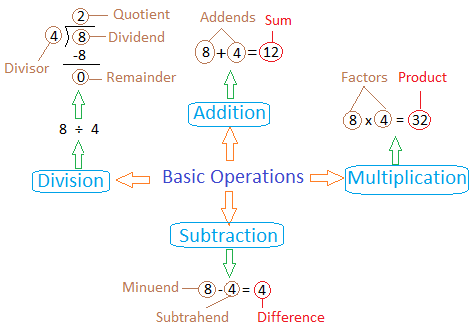
There are 4 basic operations. The graphic organizer below shows what these operations are along with some other important terms.
In this lesson, you will learn
- The 4 basic operations: addition, subtraction, multiplication and division
- The name of each number in an addition, subtraction, multiplication or division problem
- How to name every part of a division that has a remainder

Addition Terms
- Addendsthe numbers being added.
- Sumthe answer to the addition problem.
In the graphic organizer, 8 + 4 = 12. The addends are 8 and 4, and the sum is 12.
In 15 + 6 = 21, which numbers are the addends?
Show answer
15 and 6. The addends are the numbers being added. 21 is the sum.
Subtraction Terms
- Minuendthe number you are subtracting from.
- Subtrahendthe number that is to be subtracted from the minuend.
- Differencethe answer to the subtraction problem.
In the graphic organizer, 8 − 4 = 4. The minuend is 8, the subtrahend is 4, and the difference is 4.
Mixing up the minuend and the subtrahend. The minuend always comes first, because it is the number you subtract from. In 12 − 5 = 7, the minuend is 12 and the subtrahend is 5. Writing 5 − 12 gives a different problem.
In 20 − 7 = 13, which number is the subtrahend?
Show answer
7. The subtrahend is the number being subtracted from the minuend, 20. 13 is the difference.
Multiplication Terms
- Factorsthe numbers being multiplied.
- Productthe answer to the multiplication problem.
In the graphic organizer, 8 × 4 = 32. The factors are 8 and 4, and the product is 32.
In 6 × 9 = 54, what is the product?
Show answer
54. The product is the answer to the multiplication problem. 6 and 9 are the factors.
Division Terms
- Dividendthe number you need to divide.
- Divisorthe number you will use to divide.
- Quotientthe answer to the division problem.
- Remaindera leftover when the dividend could not be divided evenly.
In the graphic organizer, 8 ÷ 4 = 2. The dividend is 8, the divisor is 4, and the quotient is 2. Since 4 × 2 = 8, nothing is left over, so the remainder is 0.
- The dividend is the number you need to divide: 17.
- The divisor is the number you use to divide: 5.
- 5 goes into 17 three times, because 5 × 3 = 15 and 5 × 4 = 20 is too big. The quotient is 3.
- 17 − 15 = 2 is left over, so the remainder is 2.
- Check: 5 × 3 + 2 = 15 + 2 = 17, the dividend.
17 ÷ 5 = 3 R 2: dividend 17, divisor 5, quotient 3, remainder 2.
The remainder is always smaller than the divisor. If what is left over is as big as the divisor or bigger, the divisor fits in at least one more time.
In 23 ÷ 4 = 5 R 3, which number is the divisor?
Show answer
4. The divisor is the number you use to divide. 23 is the dividend, 5 is the quotient and 3 is the remainder.
Summary
- The 4 basic operations are addition, subtraction, multiplication and division.
- Addition: the addends are the numbers being added, and the sum is the answer.
- Subtraction: the minuend is the number you subtract from, the subtrahend is the number subtracted, and the difference is the answer.
- Multiplication: the factors are the numbers being multiplied, and the product is the answer.
- Division: the dividend is divided by the divisor, the quotient is the answer, and the remainder is what is left over.
- The remainder is always smaller than the divisor.
Test Yourself: 10-Question Quiz
Now check what you learned. Every answer is explained, and each time you play you get new questions.
Quiz complete!
Keep learning