Area of a Rhombus
A rhombus is a quadrilateral with four equal sides. You can find the area of a rhombus in three ways, depending on what you know: the diagonals, the base and height, or a side and an angle.
Area = (d₁ × d₂) ÷ 2
d₁ and d₂ are the lengths of the two diagonals. This is the formula used most often.
Three area formulas
| If you know | Area formula |
|---|---|
| Both diagonals, d₁ and d₂ | A = (d₁ × d₂) ÷ 2 |
| A side (base) b and the height h | A = b × h |
| A side s and any interior angle θ | A = s² × sin θ |
The height is the distance between two opposite sides, measured at a right angle to them. It is not the length of a slanted side.
Why the diagonal formula works
The diagonals of a rhombus have two special properties:
- They bisect each other: each diagonal cuts the other into two equal halves.
- They are perpendicular: they cross at a right angle.
Together, the diagonals split the rhombus into four identical right triangles. Rearranged, those triangles fill exactly half of a rectangle that measures d₁ by d₂. That's why the area is (d₁ × d₂) ÷ 2.
Example 1: Find the area when a diagonal is missing
Sometimes the diagonals are not given directly. In rhombus ABCD below, the diagonals cross at E. Side AB = 10 and EB = 8. Find the area of the rhombus.
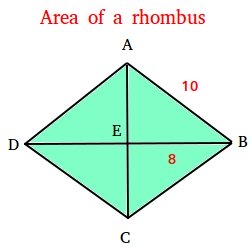
- Find diagonal DB. The diagonals bisect each other, so DE = EB = 8. Then DB = 8 + 8 = 16.
- Use the right triangle ABE. The diagonals are perpendicular, so angle AEB is a right angle. Triangle ABE has hypotenuse AB = 10 and leg EB = 8.
- Find AE with the Pythagorean theorem. AE² = 10² − 8² = 100 − 64 = 36, so AE = 6. (You can also spot the Pythagorean triple 6, 8, 10, which is 3, 4, 5 doubled.)
- Find diagonal AC. The diagonals bisect each other, so EC = AE = 6. Then AC = 6 + 6 = 12.
- Apply the formula. A = (12 × 16) ÷ 2 = 192 ÷ 2 = 96 square units.
Example 2: Using base and height
A rhombus has sides of 7.5 cm, and the distance between two opposite sides is 6 cm. What is its area?
A = b × h = 7.5 × 6 = 45 cm²
Quick check: the height of a rhombus is never longer than its side. It equals the side only when the rhombus is a square.
Example 3: Using a side and an angle
A rhombus has sides of 6 m and an angle of 30°. What is its area?
A = s² × sin θ = 6² × sin 30° = 36 × 0.5 = 18 m²
When the angle is 90°, sin 90° = 1, the rhombus is a square, and the formula becomes s².
Common mistakes: forgetting to divide by 2 in the diagonal formula, using half-diagonals (like AE) instead of full diagonals (like AC), and using a slanted side as the height.
Practice problems
Pick an answer for each question. You'll see right away whether it's correct, with an explanation.
1. The diagonals of a rhombus are 10 cm and 14 cm. What is its area?
A = (d₁ × d₂) ÷ 2 = (10 × 14) ÷ 2 = 140 ÷ 2 = 70 cm². (140 forgets to divide by 2.)
2. A rhombus has sides of 9 in and a height of 7 in. What is its area?
A = b × h = 9 × 7 = 63 in². There is no division by 2 in the base-and-height formula. (81 = 9², which would only be right for a square.)
3. A rhombus has sides of 6 cm and an angle of 30°. What is its area? (sin 30° = 0.5)
A = s² × sin θ = 6² × 0.5 = 36 × 0.5 = 18 cm².
4. A rhombus has sides of 13 m and one diagonal of 24 m. What is its area?
Half of the 24 m diagonal is 12 m. In the right triangle with hypotenuse 13 and leg 12, the other leg is √(13² − 12²) = √25 = 5 m, so the other diagonal is 2 × 5 = 10 m. A = (24 × 10) ÷ 2 = 120 m². (60 uses the half-diagonal 5 instead of 10.)
5. A rhombus has an area of 48 ft², and one diagonal is 8 ft. How long is the other diagonal?
48 = (8 × d₂) ÷ 2, so 96 = 8 × d₂ and d₂ = 12 ft. (6 forgets to multiply by 2 first.)
6. In Example 1, why is triangle ABE a right triangle?
The diagonals AC and DB cross at a right angle at E, so angle AEB = 90°. The other statements are true about a rhombus, but they don't make angle AEB a right angle.