Archimedes' Principle
Archimedes' principle was named after the Greek philosopher Archimedes. The principle is closely related to buoyancy, as you can see in the statement below.
In this lesson, you will learn
- what Archimedes' principle says about the buoyant force
- how to find the buoyant force from the weight of the displaced water
- why an object feels lighter in water, and how much lighter
- how the principle explains real-life examples, from a bathtub to a boat
What Archimedes' Principle Says
Here is what Archimedes states:
The buoyant force acting on an object that is submerged in a liquid, such as water, is equal to the weight of the liquid the object displaces.
Whether the object is fully or partially submerged, the principle is still true.
"Displaces" means "pushes out of the way". When an object goes into water, it takes up space, and the water that was in that space has to move. The buoyant force is the upward push from the water, and it is exactly as strong as the weight of the water that moved.
Buoyant force = weight of the displaced liquid
The principle works for every fluid, not only water. Air is a fluid too: a helium balloon rises because the air it displaces weighs more than the balloon.
A toy boat displaces 3 newtons of water. What is the buoyant force on it?
Show answer
3 newtons. The buoyant force equals the weight of the water the boat displaces.
Example: The Buoyant Force on a Rock
For example, suppose you submerge a rock whose weight is 10 pounds in water, and the water that is displaced weighs 4 pounds. What is the buoyant force?
Since the rock displaced 4 pounds of water, and the buoyant force is equal to the weight of the liquid that the object displaces, the buoyant force is 4 pounds.
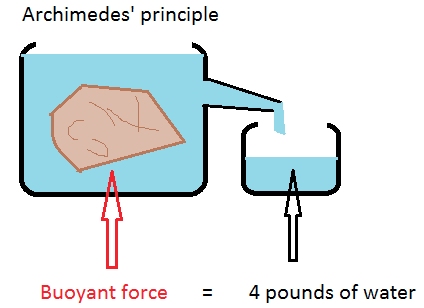
Notice that it is not the weight of the object that determines the buoyant force, but the weight of the displaced water. This situation is illustrated in the figure above. The strength of the force beneath the rock that pushes the rock up is equal to 4 pounds.
Thinking the buoyant force equals the object's own weight. The 10-pound rock gets a buoyant force of only 4 pounds, because it displaces only 4 pounds of water. That is why it sinks.
- Gravity pulls the rock down with its weight: 10 pounds.
- The water pushes it up with the buoyant force: 4 pounds.
- The two forces work against each other, so subtract: 10 − 4 = 6.
The rock feels like it weighs only 6 pounds under water.
A 25-pound stone displaces 9 pounds of water. How heavy does it feel under water?
Show answer
16 pounds. The buoyant force is 9 pounds, and 25 − 9 = 16.
Other Real-Life Examples of Archimedes' Principle
A full bathtub
You fill your bathtub with water all the way to the top, and you submerge your body in the bathtub. Some water will spill on the floor. The weight of the water that fell on the floor is equal to the buoyant force that pushes your body up.
A boat on a river
A boat on a river will be partially submerged. The boat will displace an amount of water, even if it is small. The weight of the water that was displaced is equal to the buoyant force at the bottom of the boat.
A floating boat sinks into the water until the water it displaces weighs exactly as much as the boat. Then the buoyant force balances the boat's weight. Load more cargo, and the boat sits lower in the water.
A canoe floats on a lake. The canoe and the people in it weigh 900 newtons. How much does the water it displaces weigh?
Show answer
900 newtons. A floating object displaces its own weight of water, so the buoyant force balances its weight.
Summary
- Archimedes' principle: the buoyant force on an object in a liquid equals the weight of the liquid it displaces.
- It works when the object is fully or partially submerged, and in any fluid, including air.
- The buoyant force depends on the displaced liquid, not on the object's own weight.
- Under water, an object feels lighter by the buoyant force: weight − buoyant force.
- A floating object displaces its own weight of water.
Test Yourself: 10-Question Quiz
Now check what you learned. Every answer is explained, and each time you play you get new questions.
Your result
Keep learning