Angle in Standard Position
In this lesson, you will learn
- when an angle is in standard position, and its vertex, initial side and terminal side
- why some angles are positive and others are negative
- how to find the quadrant an angle lies in
- how to find coterminal angles
What Is an Angle in Standard Position?
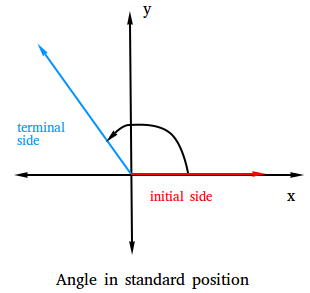
An angle in the coordinate plane is in standard position when its vertex is at the origin and its initial side lies along the positive x-axis.
Vertex at (0, 0) · Initial side on the positive x-axis
Counterclockwise rotation gives a positive angle. Clockwise rotation gives a negative angle.
The Parts of an Angle in Standard Position
Think of the angle as a ray that starts on the positive x-axis and rotates around the origin.
- Vertex: the origin, the point the ray rotates around.
- Initial side: the starting position of the ray. In standard position it always lies along the positive x-axis.
- Terminal side: the position of the ray after it has rotated.
The measure of the angle is the amount and direction of rotation needed to move from the initial side to the terminal side.
An angle in standard position turns counterclockwise until its terminal side lies on the negative x-axis, less than one full turn. What is its measure?
Show answer
180°. The ray turns half of a full turn: 360° ÷ 2 = 180°.
Positive and Negative Angles
The direction of rotation decides the sign of the angle:
- A counterclockwise rotation creates a positive angle, such as 120°.
- A clockwise rotation creates a negative angle, such as −60°.
A ray can also rotate more than one full turn. One full turn is 360°, so an angle of 400° makes one complete turn and then 40° more.
A ray in standard position turns clockwise one quarter of a full turn. What is the angle?
Show answer
−90°. A quarter turn is 360° ÷ 4 = 90°, and clockwise makes it negative.
See It on the Coordinate Plane
In the figure below, the initial side (red) lies along the positive x-axis, and the curved arrow shows the rotation to the terminal side (blue).
The next two figures show the same terminal side reached in two different ways. Rotating counterclockwise gives a positive angle. Rotating clockwise, the long way around, gives a negative angle.
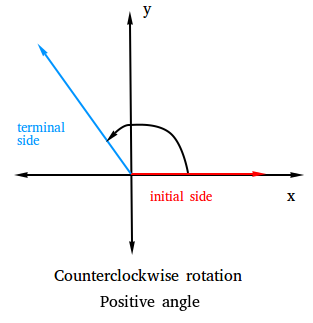
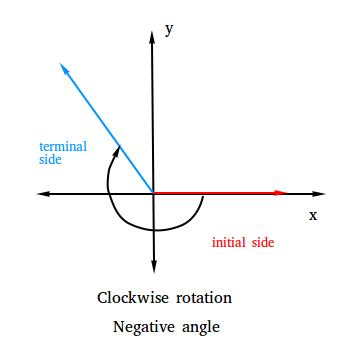
Angles that share the same terminal side, like these two, are called coterminal angles.
Which Quadrant Is the Angle In?
An angle in standard position "lies in" the quadrant where its terminal side lands. For angles between 0° and 360°:
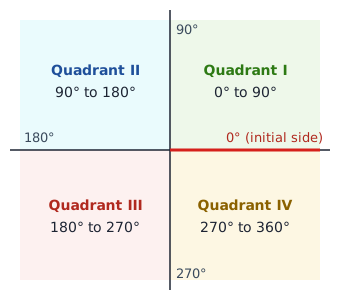
When the terminal side lands exactly on an axis (0°, 90°, 180°, 270° or 360°), the angle is not in any quadrant. These are called quadrantal angles.
In which quadrant does an angle of 310° lie?
Show answer
Quadrant IV. 310° is between 270° and 360°.
Coterminal Angles
Adding or subtracting a full turn (360°) brings the terminal side back to the same place. So every angle has infinitely many coterminal angles:
In radians, one full turn is 2π, so the coterminal angles are θ + 2πk. See radian measure.
Find one positive and one negative angle coterminal with 50°.
Show answer
410° and −310°. 50° + 360° = 410° and 50° − 360° = −310°. Other answers, such as 770°, are also correct.
Interactive Angle Explorer: Rotate the Terminal Side
Drag the blue point, use the slider, type an angle or pick an example. Watch the rotation, the quadrant and the coterminal angles change.
Examples
| Angle | Rotation | Terminal side |
|---|---|---|
| 150° | Counterclockwise 150° | Quadrant II |
| −60° | Clockwise 60° | Quadrant IV (coterminal with 300°) |
| 400° | One full turn, then 40° more | Quadrant I (coterminal with 40°) |
| −235° | Clockwise 235° | Quadrant II (coterminal with 125°) |
| 270° | Counterclockwise 270° | Negative y-axis (quadrantal) |
Tip for negative angles: add 360° until the result is between 0° and 360°. For −235°: −235° + 360° = 125°, which is in Quadrant II.
- The angle is negative, so add 360°: −480° + 360° = −120°.
- It is still negative, so add 360° again: −120° + 360° = 240°.
- 240° is between 180° and 270°.
−480° lies in Quadrant III (coterminal with 240°).
Dropping the minus sign. −60° is not in Quadrant I like 60°. It turns clockwise, so it lands in Quadrant IV, coterminal with 300°.
Summary
- An angle is in standard position when its vertex is at the origin and its initial side is on the positive x-axis.
- The terminal side is where the ray ends after rotating.
- Counterclockwise rotation gives a positive angle, and clockwise rotation gives a negative angle.
- The angle lies in the quadrant of its terminal side. Angles on an axis are quadrantal angles.
- Coterminal angles share a terminal side: θ + 360° · k, or θ + 2πk in radians.
Test Yourself: Interactive 10-Question Quiz
Now check what you learned about angles in standard position. Every answer is explained, and each time you play you get new angles.
Quiz Complete! 🎉
Keep learning