Ambiguous Case of the Law of Sines
The ambiguous case of the law of sines happens when two sides and an angle opposite one of the two sides are given. We call this situation SSA for short.
Since the length of the third side is not known, we don't know if a triangle will be formed or not. That is the reason we call this case ambiguous. In fact, this kind of situation, or SSA, can give the following 4 scenarios:
- No triangle
- 1 right triangle
- Exactly 1 triangle
- 2 triangles
In this lesson, you will learn
- what the SSA case is and why it is called ambiguous
- how to find the height h = b sin A
- how to compare a with h and b to tell how many triangles you get
- how to check your answer with the law of sines, and how to find both triangles when there are two
Scenario 1: a < h, So No Triangle Is Formed
The first scenario of the ambiguous case of the law of sines occurs when a < h.
For example, take a look at the triangle below, where only two sides are given. These two given sides are a and b. An angle opposite one side is also given. Angle A is the angle that is opposite side a, one of the two sides.
Note that SSA in this case means side a, side b, angle A, in that order.
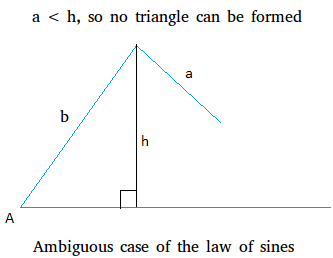
Because a is shorter than h, a is not long enough to form a triangle. In fact, the number of possible triangles that can be formed in the SSA case depends on the length of the altitude, or h.
Notice that sin A = hb.
Once you multiply both sides of the equation above by b, we get:
h = b sin A
An example showing that no triangle can be formed
Suppose A = 74°, a = 51, and b = 72.
Method #1: compare a with h
h = 72 × sin(74°) = 72 × 0.9612 ≈ 69.21
Since a = 51 is less than h ≈ 69.21, no triangle will be formed.
We can also show that no triangle exists by using the law of sines: asin A = bsin B.
The ratio asin A is known, since asin A = 51sin 74°.
Since we also know the length of b, the missing quantity in the law of sines is sin B. It is logical, then, to look for sin B and see what we end up with.
Method #2: use the law of sines
51sin 74° = 72sin B
51 sin B = 72 sin 74°
sin B = 72 sin 74°51
sin B = 72 × 0.961251
sin B = 69.206451
sin B ≈ 1.3570
Since the sine of an angle cannot be bigger than 1, angle B does not exist. Therefore, no triangle can be formed with the given measurements.
A = 30°, a = 8 and b = 20. Can a triangle be formed?
Show answer
No. h = 20 × sin 30° = 20 × 0.5 = 10, and a = 8 is less than 10.
Scenario 2: a = h, So 1 Right Triangle Is Formed
The second scenario of the ambiguous case of the law of sines occurs when a = h.
When a = h, the resulting triangle will always be a right triangle.
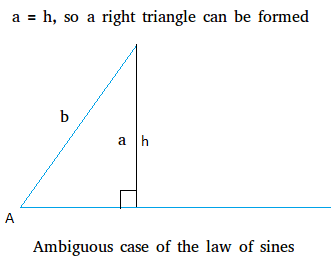
An example showing that a right triangle can be formed
Suppose A = 30°, a = 25, and b = 50.
Method #1: compare a with h
h = 50 × sin(30°) = 50 × 0.5 = 25
Since a = 25 is equal to h = 25, 1 right triangle will be formed.
Again, we can use the law of sines to show that this time angle B exists and is equal to 90 degrees.
Method #2: use the law of sines
asin A = bsin B
25sin 30° = 50sin B
25 sin B = 50 sin 30°
sin B = 50 sin 30°25
sin B = 50 × 0.525
sin B = 2525
sin B = 1
B = sin−1(1) = 90°
A = 30° and b = 18. What length of a gives exactly one right triangle?
Show answer
a = 9. The right triangle happens when a = h, and h = 18 × sin 30° = 18 × 0.5 = 9.
Scenario 3: a > h and a > b, So Exactly 1 Triangle Is Formed
The third scenario of the ambiguous case of the law of sines occurs when a > h and a > b.
When a is bigger than h, again a triangle can be formed. However, since a is bigger than b, we can only have one triangle. Try to make a triangle where a is bigger than b. You will notice that there can only be 1 such triangle.
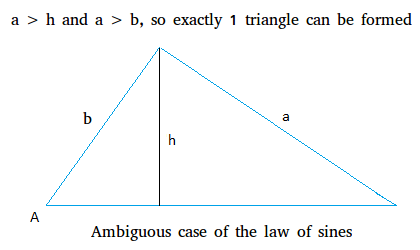
An example showing that exactly 1 triangle can be formed
Suppose A = 30°, a = 50, and b = 40.
Compare a with h and b
h = 40 × sin(30°) = 40 × 0.5 = 20
Since a = 50 is bigger than both h = 20 and b = 40, 1 triangle will be formed.
If a = b, you also get exactly 1 triangle. It is an isosceles triangle, and the second triangle shrinks to nothing.
A = 30°, a = 12 and b = 10. How many triangles can be formed?
Show answer
Exactly 1. h = 10 × 0.5 = 5, and a = 12 is bigger than both h and b.
Scenario 4: a > h and a < b, So 2 Triangles Are Formed
When a is bigger than h but less than b, 2 triangles can be formed, as clearly illustrated below. The two triangles are triangle ACD and triangle AED.
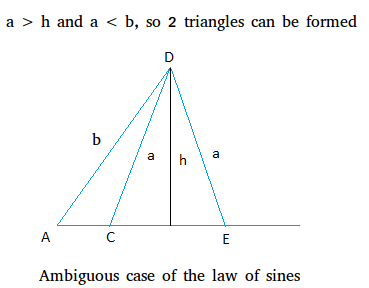
An example showing that exactly 2 triangles can be formed
Suppose A = 30°, a = 40, and b = 60.
Compare a with h and b
h = 60 × sin(30°) = 60 × 0.5 = 30
Since a = 40 is bigger than h = 30 and smaller than b = 60, 2 triangles will be formed.
- Law of sines: 40sin 30° = 60sin B, so sin B = 60 × 0.540 = 0.75.
- One angle with sin B = 0.75 is B = sin−1(0.75) ≈ 48.59°.
- The other angle with the same sine is 180° − 48.59° = 131.41°.
- Check that each one fits in a triangle with A = 30°: 30° + 48.59° = 78.59° and 30° + 131.41° = 161.41°. Both are less than 180°, so both work.
- The third angles are C ≈ 180° − 30° − 48.59° = 101.41° and C ≈ 180° − 30° − 131.41° = 18.59°.
B ≈ 48.59° in one triangle and B ≈ 131.41° in the other.
Stopping at the calculator answer. sin−1(0.75) only gives 48.59°, but 131.41° has the same sine. In the SSA case, always check whether 180° − B also fits in the triangle.
A = 30°, a = 7 and b = 10. How many triangles can be formed?
Show answer
2. h = 10 × 0.5 = 5, and a = 7 is bigger than h but smaller than b.
Summary
| Compare a with h = b sin A and with b | Number of triangles |
|---|---|
| a < h | No triangle |
| a = h | 1 right triangle |
| a ≥ b | Exactly 1 triangle |
| h < a < b | 2 triangles |
- SSA means you know side a, side b and angle A, the angle opposite side a.
- Find the height with h = b sin A, then compare a with h and b.
- With the law of sines, sin B > 1 means no triangle, and sin B = 1 means a right triangle.
- When there are 2 triangles, the two values of B add up to 180°.
- These rules are for an acute angle A. If A is 90° or more, there is exactly 1 triangle when a > b, and none otherwise.
Test Yourself: 10-Question Quiz
Now check what you learned. Every answer is explained, and each time you play you get new questions.
Your result
Keep learning