Adding Vectors
Adding vectors to find the resultant is an important skill in mathematics and also physics. Therefore, understanding the concept is important to do well in physics or mathematics.
In this lesson, you will learn
- what a vector is, and the difference between vector and scalar quantities
- how to add vectors that point in the same or in opposite directions
- how to add vectors that are not parallel, head to tail or with the parallelogram rule
- how to subtract vectors by adding the opposite
What Is a Vector?
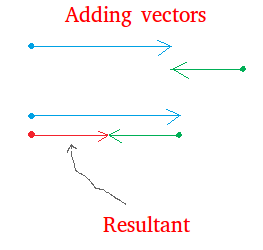
Let's say you are pushing your friend and it requires an effort of 100 pounds.
Your friend is not as strong as you are, so he is applying a force of 50 pounds.

We illustrate this situation with the two vectors above.
You are the blue vector and your friend is the green vector. Both vectors look like rays. Indeed, a vector is a directed line segment.
The little dot is called the tail or initial point and the arrow is called the head or terminal point.
I purposely made the blue vector twice as big as the green one.
Do you know why? It is because the force you are applying is twice as big as your friend's.
Both vectors give you two quantities. These quantities are the force and the direction.
You already know what the force is for you and your friend. Now you can clearly see that the direction of the force is toward the other person.
A vector is drawn 3 times as long as another vector. What does that tell you about the two forces they show?
Show answer
The first force is 3 times as big. The length of a vector shows its size (magnitude), just as the blue vector is twice as long because your force is twice as big.
Vector Quantities and Scalar Quantities
Many quantities in real life will require both magnitude and the direction. We call these quantities vector quantities.
When quantities can only be specified by their magnitude, we call them scalars.
For example, 20 kg of sugar going east makes no sense since we don't need to know the direction at all.
It makes sense then to specify 20 kg of sugar only with the magnitude that is 20 kg.
However, driving east on the highway with a speed of 60 miles per hour makes perfect sense.
It is a vector quantity with a magnitude of 60 miles per hour and a direction of east.
Is "a wind blowing 30 km per hour toward the north" a vector quantity or a scalar quantity?
Show answer
A vector quantity. It has a magnitude (30 km per hour) and a direction (north).
Adding Vectors to Find the Resultant
What is the resultant of you pushing your friend and your friend pushing you? It may make sense to you that since your force is stronger, your friend will move in the same direction that you are moving.
The net force you will be moving him with is 50 pounds.
If you and your friend join forces to push a car, notice this time that both arrows are pointing in the same direction. The force is now bigger and it is 150 pounds.
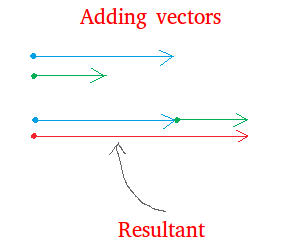
Same direction: add the magnitudes. 100 + 50 = 150 pounds.
Opposite directions: subtract the smaller magnitude from the bigger one. The resultant points in the direction of the bigger vector. 100 − 50 = 50 pounds, in your direction.
- The two vectors point in opposite directions (east and west).
- Subtract the magnitudes: 12 − 3 = 9 km per hour.
- The boat's vector is bigger, so the resultant points east.
9 km per hour east
You push a box with 80 pounds to the right and your friend pushes it with 30 pounds to the left. What is the resultant force?
Show answer
50 pounds to the right. The forces point in opposite directions, so 80 − 30 = 50, in the direction of the bigger force.
Adding Vectors When the Directed Segments Are Not Parallel
Adding vectors when the directed segments are not parallel is not very much different than when they are parallel.
You may have noticed that the initial point of the vector in green was always put at the terminal point of the vector in blue. The resultant has the same initial point as the vector in blue and the same terminal point as the vector in green.
We do the same thing when the vectors are not parallel. For example, add the following vectors:
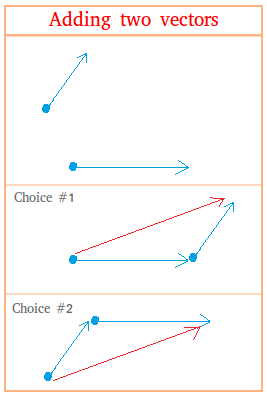
Notice that in choice #1, we put the initial point of the smaller vector at the terminal point of the bigger vector. In choice #2, we put the initial point of the bigger vector at the terminal point of the smaller vector.
Head-to-tail rule: put the tail of the second vector at the head of the first vector. The resultant goes from the tail of the first vector to the head of the second vector. The order does not matter: choice #1 and choice #2 give the same resultant.
The Parallelogram Rule
You could also use the parallelogram rule to add the two vectors above.
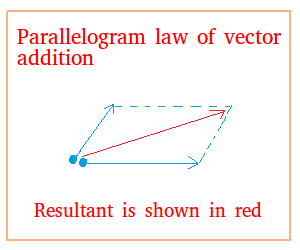
In the parallelogram rule, notice that the initial points of the vectors are put at the same point. Complete the parallelogram, and the resultant is the diagonal that starts at that point.
Adding the lengths when the vectors are not parallel. The length of the resultant equals the sum of the lengths only when the vectors point in the same direction. For example, walking 3 blocks east and then 4 blocks north puts you 5 blocks from where you started, not 7.
You add the same two vectors twice: once as choice #1 and once as choice #2. Do you get two different resultants?
Show answer
No. The red resultant is the same in both choices. The order in which you add vectors does not change the resultant.
How to Subtract Vectors
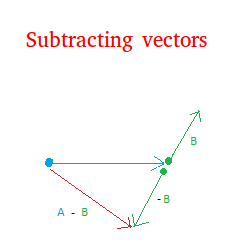
Subtracting vectors is just like adding vectors. Say you want to do A − B.
−B is the opposite of B. Both vectors have the same length, but they have opposite directions.
The figure below shows A − B.
A is the blue vector. B is the green vector pointing upward.
The vector pointing downward is the opposite of B.
A − B is the resultant vector shown in red.
Vector A is 10 units east and vector B is 4 units east. What is A − B?
Show answer
6 units east. −B is 4 units west, and A + −B = 10 east + 4 west = 6 units east.
Summary
- A vector is a directed line segment with a tail (initial point) and a head (terminal point). Its length shows its magnitude.
- Vector quantities have a magnitude and a direction. Scalar quantities have only a magnitude.
- Same direction: add the magnitudes. Opposite directions: subtract them, and the resultant points the way of the bigger vector.
- To add any two vectors, put them head to tail, or tail to tail with the parallelogram rule. The resultant is the same either way.
- To subtract, add the opposite: A − B = A + −B.
Test Yourself: 10-Question Quiz
Now check what you learned. Every answer is explained, and each time you play you get new questions.
Quiz complete!
Keep learning