Adding Polynomials using Algebra Tiles, Horizontally, and Vertically
Adding polynomials by combining like terms together and using algebra tiles is the goal of this lesson. We will show you the following three ways to add polynomials.
- Using algebra tiles
- Adding vertically
- Adding horizontally
In this lesson, you will learn
- how to model and add polynomials with algebra tiles, including negative tiles that cancel
- what like terms are and why only like terms can be added
- how to add polynomials by lining up like terms (vertically)
- how to add polynomials by grouping like terms (horizontally)
Adding Polynomials with Algebra Tiles
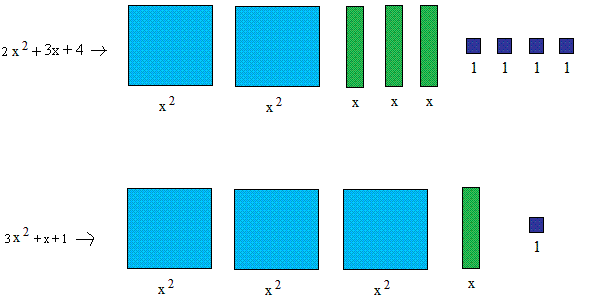
We will start with algebra tiles since the process is a lot more straightforward and concrete with tiles. To this end, study the model below with great care.


Example #1: Add 2x2 + 3x + 4 and 3x2 + x + 1
Step 1
Model both polynomials with tiles.
Step 2
Combine all tiles that are alike and count them.
You got a total of 5 light blue square tiles, so 5x2
You got a total of 4 green rectangle tiles, so 4x
You got a total of 5 blue small square tiles, so 5
Putting it all together, we get 5x2 + 4x + 5
I hope from the above modeling, it is clear that we can only combine tiles of the same type. For example, you could not add light blue square tiles to green rectangle tiles just like it would not make sense to add 5 potatoes to 5 apples. Try adding 5 potatoes to 5 apples and tell me if you got 10 apples or 10 potatoes. It just does not make sense!
You model x2 + 2x + 3 and 2x2 + 3x + 1 with tiles. How many tiles of each kind do you have in all, and what is the sum?
Show answer
3 light blue squares, 5 green rectangles and 4 small blue squares, so 3x2 + 5x + 4. Count each kind of tile separately: 1 + 2 = 3, 2 + 3 = 5 and 3 + 1 = 4.
Adding Polynomials with Negative Tiles
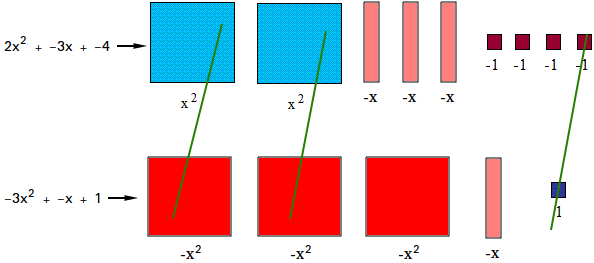
Example #2: Add 2x2 + −3x + −4 and −3x2 + −x + 1
Step 1
Model both polynomials with tiles.
Step 2
Combine all tiles that are alike and count them. Tiles that are alike, but have different colors will cancel each other out. We show each cancellation with a green line.
You are left with 1 red square tile, so −x2
You got a total of 4 light red rectangle tiles, so −4x
You are left with 3 strong pink small square tiles, so −3
Putting it all together, we get −x2 + −4x + −3
Adding a negative term is the same as subtracting: −x2 + −4x + −3 can also be written as −x2 − 4x − 3.
You have 2 green x tiles and 2 light red −x tiles. What do they add up to?
Show answer
0. Each x tile cancels one −x tile, so no x tiles are left: 2x + −2x = 0.
Keep These Important Facts in Mind When Adding Polynomials
We call tiles that are alike or are the same type "like terms".
Like terms are terms with the same variable and the same exponent. For example, 2x2 and 3x2 in example #1 are like terms because they have the same variable, x and the same exponent, 2.
To add like terms, just add the coefficients, or the numbers attached to the term, or the number on the left side of the term.
Adding the exponents. 2x2 + 3x2 is 5x2, not 5x4: the exponent stays the same. And terms that are not alike, such as 3x2 + 2x, cannot be combined into one term.
Are 4x3 and 4x2 like terms?
Show answer
No. They have the same variable and the same coefficient, but the exponents are different (3 and 2).
Adding Polynomials Vertically
Line up like terms. Then add the coefficients.
Example #3: Add 6x2 + 8x + 9 and 2x2 + −13x + 2
| 6x2 | + 8x | + 9 | |
| + | 2x2 | + −13x | + 2 |
| 8x2 | + −5x | + 11 |
Example #4: Add −5x3 + 4x2 + 6x + −8 and 3x3 + −2x2 + 4x + 12
| −5x3 | + 4x2 | + 6x | + −8 | |
| + | 3x3 | + −2x2 | + 4x | + 12 |
| −2x3 | + 2x2 | + 10x | + 4 |
Line up and add: x2 + 5x + −7 and 4x2 + −2x + 3.
Show answer
5x2 + 3x + −4. Column by column: 1 + 4 = 5, 5 + −2 = 3 and −7 + 3 = −4.
Adding Polynomials Horizontally
Example #5: Add 6x2 + 2x + 4 and 10x2 + 5x + 6
Combine or group all like terms. You could use parentheses to keep things organized.
(6x2 + 2x + 4) + (10x2 + 5x + 6) = (6x2 + 10x2) + (2x + 5x) + (4 + 6)
(6x2 + 2x + 4) + (10x2 + 5x + 6) = (6 + 10)x2 + (2 + 5)x + (4 + 6)
Add the coefficients.
(6x2 + 2x + 4) + (10x2 + 5x + 6) = 16x2 + 7x + 10
Example #6: Add 2x4 + 5x3 + −x2 + 9x + −6 and 10x4 + −5x3 + 3x2 + 6x + 7
(2x4 + 5x3 + −x2 + 9x + −6) + (10x4 + −5x3 + 3x2 + 6x + 7)
= (2x4 + 10x4) + (5x3 + −5x3) + (−x2 + 3x2) + (9x + 6x) + (−6 + 7)
= (2 + 10)x4 + (5 + −5)x3 + (−1 + 3)x2 + (9 + 6)x + (−6 + 7)
= (12)x4 + (0)x3 + (2)x2 + (15)x + (1)
= 12x4 + 2x2 + 15x + 1
Notice that if the term is x2, you can rewrite it as 1x2, so your coefficient is 1. In the same way, −x2 = −1x2, so its coefficient is −1. We did this in example #6, third line with (−x2 + 3x2)
(−x2 + 3x2) = (−1x2 + 3x2)
- Group like terms: (3x2 + −x2) + (−5x + 5x) + (7 + −2)
- Write −x2 as −1x2 and add the coefficients: (3 + −1)x2 + (−5 + 5)x + (7 + −2)
- Simplify: 2x2 + 0x + 5
- A term with coefficient 0 is 0, so leave it out.
2x2 + 5
Add (4x3 + x + 2) + (x3 + 3x2 + −6). Watch the missing terms.
Show answer
5x3 + 3x2 + x + −4. x3 terms: 4 + 1 = 5. Only the second polynomial has an x2 term: 3x2. Only the first has an x term: x. Constants: 2 + −6 = −4.
Summary
- Like terms have the same variable and the same exponent. Only like terms can be added.
- To add like terms, add the coefficients and keep the variable and exponent: 2x2 + 3x2 = 5x2.
- With algebra tiles, count each kind of tile. A positive and a negative tile of the same kind cancel out.
- Vertically: line up like terms in columns, then add each column.
- Horizontally: group like terms in parentheses, then add the coefficients. Leave out any term whose coefficient is 0.
Test Yourself: 10-Question Quiz
Now check what you learned. Every answer is explained, and each time you play you get new questions.
Quiz complete!