Absolute Value of a Complex Number
In this lesson, you will learn
- what the absolute value (modulus) of a complex number means on the complex plane
- how the distance formula gives |a + bi| = √(a)2 + (b)2
- how to find the absolute value of numbers like 4 − 3i and 6i
What Is the Absolute Value of a Complex Number?
The absolute value of a complex number a + bi, also called the modulus of a complex number a + bi, is its distance from the origin on the complex number plane.
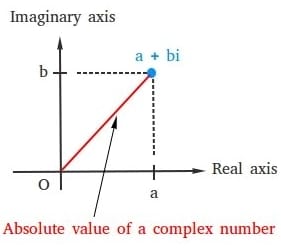
On the complex plane, the complex number a + bi is represented as a point (a, b) and the coordinate of the origin is (0, 0).
a is the real part and b is the number in front of i. For 4 − 3i, a = 4 and b = −3 (not −3i), so the point is (4, −3).
Which point represents −2 + 5i on the complex plane?
Show answer
(−2, 5). The real part −2 is the first coordinate and the number in front of i, 5, is the second coordinate.
The Formula for the Absolute Value of a Complex Number
Just find the distance between (0, 0) and (a, b).
We can use the distance formula to find the absolute value of a complex number.
Distance=√(a − 0)2 + (b − 0)2
Distance=√(a)2 + (b)2
Adding a and b instead of using the formula. For 4 − 3i, 4 + (−3) = 1, but |4 − 3i| = 5. Square a and b, add the squares, then take the square root.
What is |3 + 4i|?
Show answer
5. |3 + 4i| = √(3)2 + (4)2 = √9 + 16 = √25 = 5.
Two Examples Showing How to Find the Absolute Value of a Complex Number
Find the absolute value of the complex numbers 4 − 3i and 6i.
Notice that 6i = 0 + 6i.
|4 − 3i|
|4 − 3i| = √(4)2 + (−3)2
|4 − 3i| = √16 + 9 = 5
|6i|
|6i| = √(0)2 + (6)2
|6i| = √0 + 36 = 6
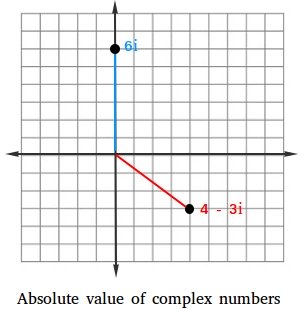
The figure below shows the distance for the complex number 4 − 3i in red and the distance for the complex number 6i in blue.
- Find a and b: a = −5 and b = 12.
- Square each one: (−5)2 = 25 and (12)2 = 144.
- Add the squares: 25 + 144 = 169.
- Take the square root: √169 = 13.
|−5 + 12i| = 13
What is |1 − i|?
Show answer
√2. Here a = 1 and b = −1, so |1 − i| = √(1)2 + (−1)2 = √2, which is about 1.41. The answer does not have to be a whole number.
Summary
- The absolute value (modulus) of a + bi is its distance from the origin on the complex plane.
- The number a + bi is the point (a, b), and b is the number in front of i.
- Use the distance formula: |a + bi| = √(a)2 + (b)2.
- For a number like 6i, use a = 0: |6i| = 6. The absolute value is never negative.
Test Yourself: 10-Question Quiz
Now check what you learned. Every answer is explained, and each time you play you get new questions.
Quiz Complete!